

In the architecture of a successful brewery, the fermentation cellar is arguably the most critical component for long-term growth and consistency. While the brewhouse is the “kitchen” where the wort is prepared, the fermentation tanks are the “bedrooms” where the yeast does the heavy lifting of turning sugary liquid into beer. Choosing the right fermentation tank size is not merely a matter of picking a volume that fits your current needs; it is a complex calculation involving your brewhouse capacity, your sales velocity, your beer styles, and your future expansion plans.
Selecting a tank that is too small leads to operational inefficiencies and wasted labor, while selecting tanks that are too large can lead to quality issues and wasted capital. This guide explores the multi-faceted approach to determining the ideal fermentation vessel (FV) size for your brewing operation.
The Golden Rule: The Brewhouse to Fermenter Ratio
The most fundamental starting point for sizing your tanks is the capacity of your brewhouse. In the professional brewing world, tank sizes are almost always discussed in terms of “multiples.”
Single-Batch Tanks (1:1 Ratio)
A 1:1 ratio means the fermentation tank matches the output of a single brew day. For example, if you have a 10BBL brewhouse, you buy 10BBL fermenters. This is the simplest configuration and is ideal for small brewpubs or start-ups. It allows for maximum flexibility, as every brew can be a different recipe. However, it is the least efficient in terms of labor and equipment cost per barrel produced.
Double-Batch Tanks (2:1 Ratio)
A 2:1 ratio is widely considered the industry “sweet spot” for growing microbreweries. In this scenario, you brew twice in one day (or over two days) to fill a single 20BBL fermenter with your 10BBL brewhouse. This significantly reduces the cost of the tank per barrel and halves the amount of cleaning, CIP (Clean-In-Place) chemicals, and sensor maintenance required for that volume of beer.
Large-Scale Multiples (4:1 and Beyond)
Production breweries often utilize 4:1 or even 10:1 ratios. While this offers incredible economies of scale, it requires a brewhouse and a team capable of brewing around the clock. If it takes you 24 hours to fill a tank, the yeast added during the first batch may already be well into its growth phase by the time the final batch arrives, which can lead to fermentation inconsistencies if not managed perfectly.
Accounting for Headspace and Ullage
One of the most common mistakes new brewers make is buying a tank that matches their liquid volume exactly. In reality, a fermentation tank must be significantly larger than the volume of beer it holds.
The Krausen Factor
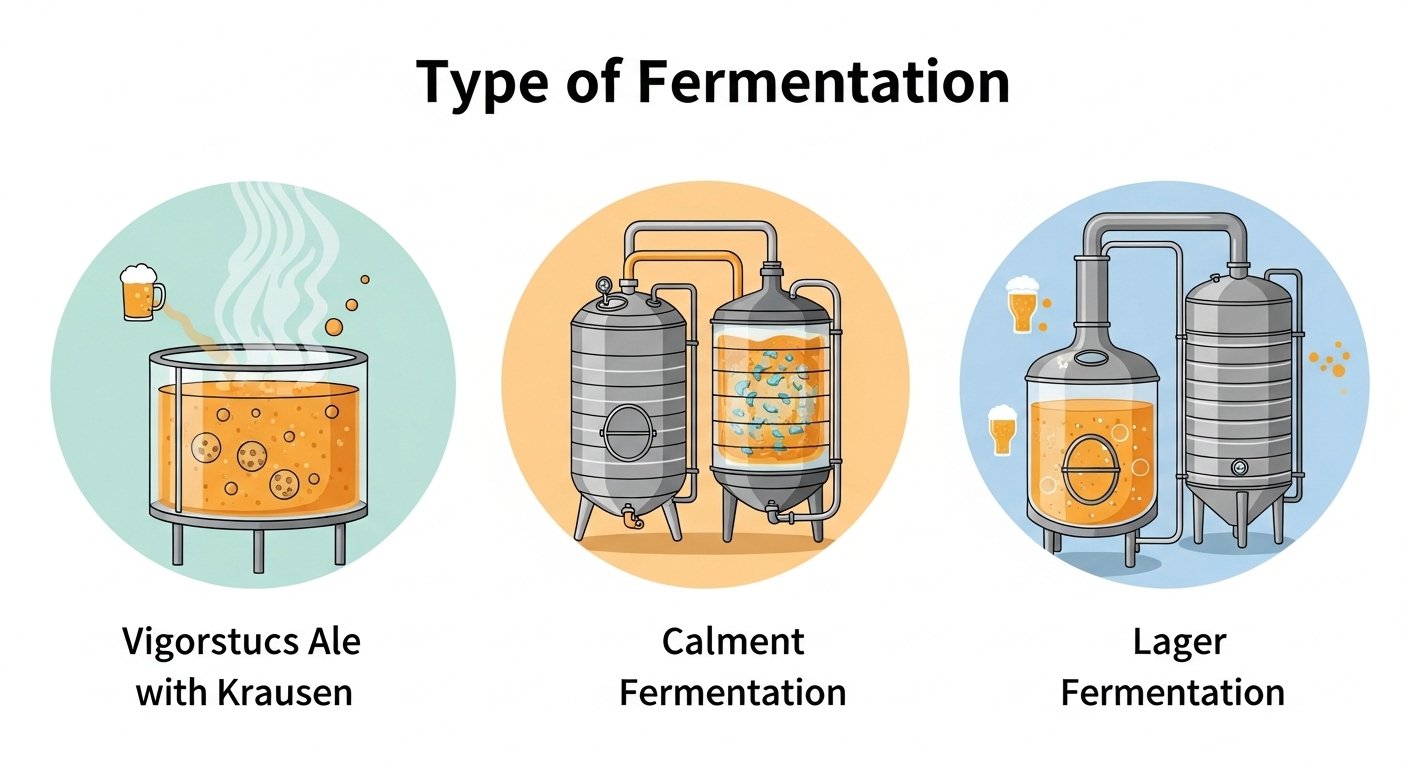
When yeast ferments, it produces carbon dioxide and a thick foam called “krausen.” If a tank is too full, this foam will exit through the blow-off arm, leading to beer loss, potential contamination, and a massive mess in the cellar.
Standard Headspace Requirements
A well-designed fermentation tank should generally have 25% to 30% headspace. This means a “10BBL Fermenter” should actually have a total internal volume of approximately 12.5 to 13 barrels. When shopping for tanks, always ask the manufacturer for the “total volume” versus the “working volume.” If you plan on brewing high-gravity beers or using expressive yeast strains (like Hefeweizen or Kveik), you may even require up to 40% headspace.
Beer Styles and Cellar Residency Time
Your tank size is inextricably linked to the type of beer you brew. The “residency time”—how long a beer sits in a tank—dictates how many tanks you need and how large they should be to meet your sales goals.
Ales vs. Lagers
Ales typically have a cellar turnaround of 14 to 21 days. This allows for a relatively quick rotation of tanks. Lagers, however, require a “lagering” or cold-storage phase that can last anywhere from 4 to 8 weeks. If your business model is focused on authentic Pilsners, you will need either significantly more fermentation tanks or much larger ones to compensate for the fact that each tank is “occupied” for twice as long as an Ale tank.
High-Gravity and Dry-Hopped Beers
Beers with high alcohol content or those that undergo heavy dry-hopping often require more time for the yeast to finish and for the sediment to settle. If you are a specialist in Double IPAs, your tank turnover will be slower. You must size your tanks to ensure that a “stuck” or slow-moving batch doesn’t create a bottleneck that shuts down your brewhouse production.
Physical Constraints: Height, Width, and Weight
Sometimes, the “right” size is determined by the building rather than the beer. Before ordering large vessels, a thorough site survey is mandatory.
Ceiling Heights
Fermentation tanks are vertical vessels. A 30BBL fermenter can easily stand 12 to 14 feet tall once you account for the cooling jackets, the stand, and the top-mounted ports. You must also leave at least 2 feet of clearance above the tank to allow for the installation of spray balls and the removal of the dry-hop port cover.
Floor Loading Capacity
A full fermentation tank is incredibly heavy. Water weighs approximately 8.34 pounds per gallon. A 20BBL tank contains 620 gallons of beer, weighing over 5,000 pounds—not including the weight of the stainless steel tank itself. You must ensure your brewery floor is a reinforced concrete slab (typically 4 to 6 inches thick) capable of handling these concentrated point loads without cracking or sinking.
Future-Proofing and Scalability
It is almost always cheaper to buy a larger tank now than to replace a small tank later. This is known as “future-proofing.”
The “Empty Space” Strategy
If you have the floor space and the ceiling height, consider buying tanks that are one step larger than your current needs. For example, if you are starting with a 5BBL brewhouse, buying 10BBL fermenters allows you to “double-batch” into them immediately. This gives you room to grow your sales without having to buy new equipment, pull permits, or hire installers six months after opening.
Standardizing Tank Sizes
As you grow, try to keep your tank sizes consistent. Having a cellar with two 5BBL tanks, three 10BBL tanks, and one 20BBL tank is an operational nightmare. Standardizing on, for example, 20BBL multiples allows your team to use the same yeast pitches, the same cleaning cycles, and the same filtration setups for every tank in the building.
Technical Features to Consider
When selecting a size, the dimensions (aspect ratio) also matter. A “squat” tank and a “slim” tank might both hold 10BBL, but they will perform differently.
Aspect Ratio and Conical Angle
The standard for modern craft brewing is a height-to-diameter ratio of roughly 2:1 or 3:1. This promotes healthy convection currents during fermentation. Additionally, the bottom cone should be angled at 60 degrees. This specific angle is the industry standard for ensuring that yeast and trub settle effectively into the bottom for easy removal or harvesting.
Cooling Jacket Configuration
The larger the tank, the more surface area is required for cooling. Ensure that the tank size you choose has multiple “zones” of glycol jackets. For a 20BBL tank, you should have at least one jacket on the cone and two separate jackets on the sidewall. This allows you to cool the beer even when the tank is only half-full.
Financial Considerations: The Cost per Barrel
When evaluating tank sizes, look at the Cost per Barrel of Capacity.
- A 5BBL fermenter might cost $6,000 ($1,200 per BBL).
- A 10BBL fermenter might cost $8,500 ($850 per BBL).
- A 20BBL fermenter might cost $12,000 ($600 per BBL).
As you can see, the price of the stainless steel does not double when the volume doubles. The labor to build the tank is roughly the same. Therefore, the larger the tank you can reasonably fit and fill, the lower your overhead will be for every pint you sell.
Why Choose Micet for Your Fermentation Needs?
Navigating the complexities of tank sizing requires a partner with deep engineering expertise. Micet is a premier manufacturer of stainless steel brewing equipment, offering a vast array of fermentation vessels designed to meet the rigorous demands of the craft beer industry.
Micet’s fermentation tanks are built with the brewer’s future in mind. Their products feature:
- Superior Construction: Made from 304 or 316L high-grade stainless steel with precision TIG welding and a sanitary $0.4\mu\text{m}$ Ra interior finish.
- Custom Engineering: Micet doesn’t just offer “off-the-shelf” sizes. They work with you to customize tank heights and widths to fit your specific building constraints.
- High-Efficiency Cooling: Dimpled glycol jackets are strategically placed to provide maximum thermal exchange, ensuring your yeast stays at the perfect temperature throughout the fermentation cycle.
- Turnkey Integration: Whether you need a single 1BBL pilot tank or a battery of 100BBL outdoor fermenters, Micet provides the valves, sensors, and control systems needed for a seamless installation.
By choosing Micet, you are investing in equipment that balances aesthetic beauty with industrial-strength performance, ensuring your brewery is set up for success from day one.
Frequently Asked Questions
1. Can I ferment a 5BBL batch in a 10BBL tank?
Yes, but with caveats. You must ensure the glycol cooling jackets are positioned low enough on the tank to reach the liquid level of the 5BBL batch. Additionally, having 50% headspace means there is a lot of oxygen in the tank initially. You must be extra diligent about purging the headspace with $CO_2$ to prevent oxidation, and your yeast may behave differently due to the lower hydrostatic pressure.
2. How do I know if my ceiling is high enough for a specific tank?
Always ask the manufacturer for the “Overall Height” (OAH), which includes the legs and the topmost fitting. You must also account for the “Shadow.” When you tilt a tall tank up from its side to stand it vertically, the diagonal measurement of the tank is longer than its height. This is called the “pivot height.” If your ceiling is exactly the same height as the tank, you won’t be able to stand it up!
3. What is the advantage of a “horizontal” fermentation tank?
While vertical conical tanks are the standard for most craft beers, horizontal tanks are traditional for lagering. The large surface area and shallow depth of a horizontal tank reduce the pressure on the yeast, which can result in a cleaner flavor profile for traditional German-style lagers. However, they take up significantly more floor space and are harder to clean than vertical tanks.