

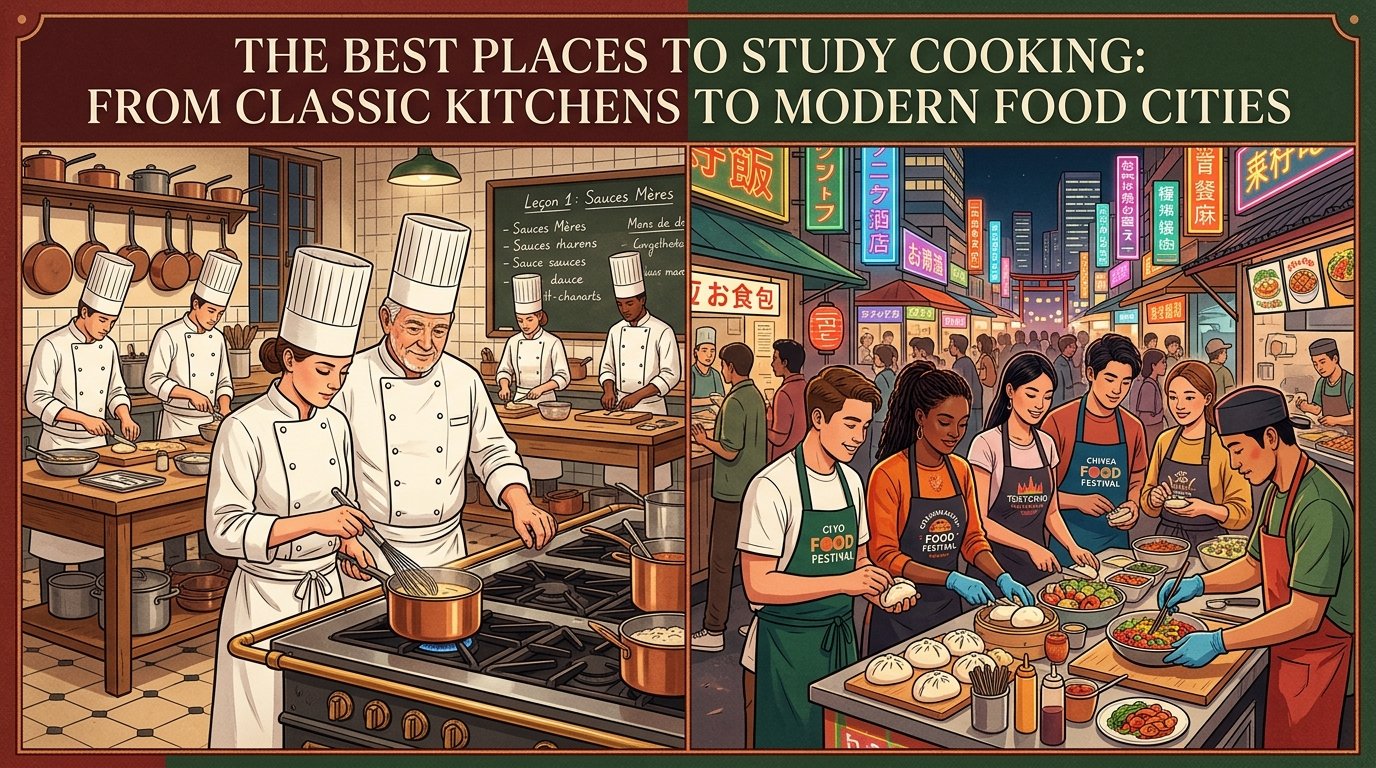
Choosing the best country for culinary school is harder than it looks. Most people jump straight to France, Italy, Japan, or the United States. Those answers make sense, but they are not enough. A good cooking school is not only about famous dishes, beautiful kitchens, or a respected name on a certificate. It is also about money, language, daily life, internships, teaching style, and what kind of career the student wants after graduation.
A country can have amazing food and still be the wrong place for one student. Another country may not sound as glamorous, but it may offer better training, lower costs, easier communication, and stronger job options. A future pastry chef, sushi chef, hotel chef, restaurant owner, and food entrepreneur should not all choose the same place.
The best country for cooking school depends on the student. Still, some countries stand out for clear reasons. France remains the strongest choice for classical cooking and pastry. Italy is excellent for ingredient-led food and regional cooking. Japan is powerful for discipline and precision. Spain is strong for creativity and modern restaurants. The United States is the best fit for students who want food and business together. The United Kingdom works well for English-speaking students who want international food culture. Switzerland is a serious option for hospitality and hotel careers.
The real question is not, “Which country has the best food?” The better question is, “Which country will help this student become the cook they want to be?”
France: Still the Strongest Name for Classical Training
France is the country many people think of first when they hear “culinary school.” That reputation is not just marketing. French cooking shaped much of the language and structure used in professional kitchens. Sauces, stocks, knife cuts, pastry methods, kitchen ranks, and fine-dining systems all have strong French roots.
For students who want serious classical training, France is still one of the best choices. A good French program teaches the basics slowly and carefully. Students learn how to make sauces, prepare fish, cook meat, handle dough, build desserts, and plate food with control. The point is not only to cook French dishes. The point is to learn methods that can be used later in many kinds of kitchens.
France is especially strong for pastry. Students who want to work with croissants, tarts, chocolate, custards, plated desserts, sugar work, and laminated dough often choose France for a reason. Pastry leaves little room for guessing. Temperature, timing, measurement, and technique matter. French training can be strict, but that strictness helps students understand why small mistakes change the final result.
The country also teaches outside the classroom. Bakeries, markets, cheese shops, wine regions, cafés, and bistros are part of daily life. A student can learn by watching how people buy bread, how a menu is written, how cheese is served, and how much attention is given to small details.
The downside is cost. Famous schools in France can be expensive, especially in Paris. Rent, transport, tools, uniforms, ingredients, and living costs can push the full price much higher than expected. Students should not judge a school only by tuition. They need to calculate the real cost of living there for the full course.
Language is another issue. Some schools teach in English, but French helps a lot outside class. Internships, part-time work, markets, and local kitchens often require at least basic French. A student who refuses to learn the language may miss many of the best parts of studying there.
France is best for students who want structure, technique, pastry, and a name that carries weight. It is not the cheapest option, and the kitchen culture can feel formal. But for classical culinary education, France still has the strongest overall case.
Italy: Best for Students Who Care About Ingredients
Italy teaches cooking in a different way. It is less about formal systems and more about food culture, regions, and ingredients. That does not mean Italian training is casual or easy. A simple Italian dish can be hard to get right because there is nowhere to hide.
A plate of pasta with a few ingredients needs good judgment. The pasta must be cooked properly. The sauce must be balanced. The oil, cheese, herbs, and salt must work together. If one part is weak, the whole dish suffers. Italian cooking often teaches students to pay attention to basic things before chasing complicated techniques.
Italy is also one of the best countries for learning regional food. Food in Bologna is not the same as food in Naples. Sicily, Tuscany, Piedmont, Liguria, Rome, and Emilia-Romagna all have different habits, ingredients, and traditions. A student who studies in Italy can see how food changes from one region to another. That is valuable for anyone who wants to build a strong restaurant identity later.
Italy is a strong choice for students interested in pasta, bread, olive oil, wine, cheese, cured meats, vegetables, seafood, and simple cooking done well. It is also a good place for students who want to open a trattoria, bakery, café, pasta shop, or ingredient-led restaurant.
The cost can be more manageable than some elite schools in France, the United States, or the United Kingdom. Big cities such as Milan, Rome, and Florence can still be expensive, but smaller cities may offer better value. Students can often find shorter programs, regional schools, and specialized courses.
Language matters here too. Some schools offer English-language programs, but daily life becomes richer when the student learns Italian. Speaking with market sellers, restaurant owners, local cooks, and landlords becomes easier. It also helps during internships, where English may not be enough.
Italy is not always the best place for students who want a highly formal fine-dining system or a strong business degree. It is better for students who want to understand food through place, season, product, and tradition. For many cooks, that kind of learning is more useful than a long list of complicated techniques.
Japan: Best for Discipline, Detail, and Repetition
Japan is one of the most serious countries in the world for food training, but it is not an easy choice. Students who go there need patience. They also need respect for a culture where learning often happens through watching, repeating, and correcting small details over time.
Japanese culinary training can feel slow to outsiders. A student may spend a long time on knife work, rice, broth, fish preparation, or one specific cooking method. That can frustrate someone who wants quick variety. But the slow pace is part of the training. It builds control.
Japan is especially strong for students interested in sushi, ramen, soba, tempura, kaiseki, wagashi, fermentation, seafood, rice, and knife skills. It teaches accuracy, cleanliness, timing, and restraint. A good Japanese kitchen does not always reward loud creativity. It rewards care, consistency, and attention.
The food culture outside school is also rich. A student can learn from ramen shops, sushi counters, department store food halls, tea shops, markets, bakeries, izakayas, and small neighborhood restaurants. Japan shows how much care can go into food at many price levels, from a simple bowl of noodles to a formal meal.
The biggest barrier is language. English-language programs exist, but deeper training often requires Japanese. Internships and apprenticeships may be difficult without it. Cultural differences can also be challenging. Some expectations are not explained directly. Students may need to watch carefully and adjust.
Japan is not the best choice for everyone. It may not suit students who want broad global cuisine, fast career movement, or a relaxed classroom style. It is better for students who want to improve their habits, build patience, and learn a high level of detail.
For the right student, Japan can be life-changing. But it should be chosen with clear eyes. The food may be beautiful, but the training can be demanding.
Spain: Best for Creative Modern Cooking
Spain has become one of the most exciting countries for culinary education. It has strong regional traditions, but it also has a modern restaurant culture that likes to test new ideas. That mix makes Spain a strong choice for students who want both roots and creativity.
Spanish food is not one simple category. Basque Country, Catalonia, Galicia, Andalusia, Valencia, Madrid, and the islands all bring different ingredients and cooking styles. Students can learn seafood, rice dishes, cured meats, olive oil, tapas, pintxos, stews, bread, and regional home cooking.
Spain is also known for modern restaurant thinking. Many Spanish chefs helped change how people think about tasting menus, texture, plating, and playful food. A student interested in contemporary dining may find Spain more open than countries with older and stricter culinary traditions.
The cost can be more reasonable than Paris, London, New York, or Switzerland, though famous food cities such as Barcelona, Madrid, and San Sebastián are not cheap. Students should compare total costs carefully, not only tuition.
Spanish is useful, but it may be easier for many students to learn than some other languages. English-language programs are available, but Spanish helps with internships, local kitchens, shopping, and friendships. Students who learn the language will get more from the country.
Spain is best for students who want modern cuisine, Mediterranean ingredients, seafood, relaxed food culture, and creative restaurant ideas. It is also a good fit for students who want serious food without feeling trapped by old rules.
Spain may not beat France for classical prestige or Japan for precision. But for students who want to cook in a modern, open-minded way, it is one of the strongest choices.
The United States: Best for Food Business and Career Range
The United States is not always treated as the romantic answer, but it may be the best country for students who see cooking as part of a bigger career. American culinary education often connects food with business, management, media, branding, and entrepreneurship.
This matters because many cooks do not stay on the line forever. Some open restaurants. Some run catering companies. Some move into hotels, product development, private dining, food media, consulting, or operations. A school that teaches costing, menu planning, purchasing, food safety, leadership, and restaurant finance can be very useful.
The U.S. also has a huge restaurant market. Students can find fine dining, diners, barbecue, food trucks, fast casual brands, bakeries, hotels, farm-to-table restaurants, immigrant food communities, and large hospitality groups. That variety helps students see many ways to build a food career.
English is another advantage for many international students. Classes, paperwork, job searches, and daily life may be easier than in countries where the student must learn a new language from the beginning.
The biggest issue is price. Culinary school in the U.S. can be very expensive. Tuition, rent, health insurance, transport, books, uniforms, and tools can create serious debt. Students should be careful with famous names. A respected school can help, but it does not guarantee a high salary after graduation.
Visa rules are also important. Studying in the United States does not automatically give someone the right to stay and work long-term. International students need to check legal work options before committing.
The United States is best for students who want business skills, career variety, and a broad view of the food industry. It may not be the best choice for someone who only wants classical technique at the lowest price. But for future restaurant owners and food entrepreneurs, it can be a smart choice.
The United Kingdom: Best for English-Language Access
The United Kingdom is not always the first country people mention when discussing cooking schools, but it can be a very practical choice. For many international students, the biggest advantage is simple: English.
Studying in English makes life easier. Students can understand lessons, contracts, job listings, housing rules, and kitchen instructions without fighting a language barrier every day. That can reduce stress and help them focus on cooking.
The UK also has a diverse food scene. London offers fine dining, bakeries, hotel kitchens, private clubs, markets, casual restaurants, and cuisines from many communities. Manchester, Birmingham, Bristol, Edinburgh, Glasgow, and other cities also have strong food cultures. A student can study classic techniques while being exposed to food from around the world.
British culinary education can be good for students interested in hotels, restaurants, catering, pastry, and international kitchens. It may not have the same emotional pull as France or Italy, but practical access matters. A student who can communicate, work, and build contacts may get more value than they would in a more famous country where daily life feels difficult.
Cost depends heavily on location. London is expensive. Smaller cities may be more manageable. Students should compare rent, transport, tuition, tools, and visa costs before choosing.
The UK is best for students who want English-language study, a global food scene, and access to hospitality careers. It may not be the best country for learning one deep national cuisine, but it is strong for broad professional training.
Switzerland: Best for Hospitality and Hotels
Switzerland deserves attention because it is strong in hospitality education. It may not be the first country people choose for cooking alone, but it is one of the best options for students who want hotel kitchens, resorts, luxury hospitality, food and beverage management, or international service careers.
Swiss schools often combine culinary training with management, service, operations, and business. That makes sense for students who want to move beyond the kitchen line. A graduate may aim for hotels, resorts, cruise lines, private clubs, or food and beverage leadership roles.
The learning environment is usually international and structured. Students may study with classmates from many countries, which prepares them for global hospitality work. Standards around service, timing, presentation, and professionalism are often high.
The main problem is cost. Switzerland is expensive, and many schools are not cheap. Students need a clear career plan before choosing it. It makes more sense for someone who wants hospitality leadership than for someone who wants to open a small café.
Language depends on the region and school. English is common in many international programs, but French, German, or Italian can help outside class and during internships.
Switzerland is best for students who want hotels, resorts, and high-end hospitality. It is not the best low-cost option, but for a specific career path, it can be very useful.
Other Countries Can Be Better for Specific Goals
The most famous culinary school countries are not the only good choices. Some students may learn more in countries with strong food cultures but less global school branding.
Thailand is excellent for students interested in herbs, chilies, noodles, rice, curry pastes, coconut, fish sauce, grilling, street food, and fast flavor balance. Thai cooking teaches students to adjust taste quickly and understand how sweet, sour, salty, spicy, and aromatic elements work together.
Mexico is one of the world’s great food countries. Students can learn corn, masa, chiles, moles, beans, salsas, seafood, slow cooking, regional food, and Indigenous traditions. Mexican cuisine has huge depth, and serious students should not treat it as casual food.
Peru is strong for seafood, potatoes, corn, chilies, altitude-based cooking, and modern restaurant identity. South Korea teaches fermentation, rice, soups, noodles, barbecue, and shared meals. India teaches spices, breads, rice, vegetarian cooking, regional food, and layered flavor. Turkey, Morocco, Greece, and Vietnam also offer deep learning for students with specific goals.
These countries may not always offer the same international school reputation as France or the U.S., but they can be powerful places to learn. A student who wants a formal diploma may still choose a famous school. A student who wants deep cultural learning may choose a country where food is part of daily life.
Price, Language, and Lifestyle Should Decide More Than Rankings
Students often look at school rankings before asking practical questions. That can lead to bad decisions. The better approach is to study the full picture.
Cost should come first. Students need to count tuition, rent, tools, uniforms, books, ingredients, transport, insurance, visa fees, flights, and emergency money. A cheap program in an expensive city may not be cheap at all. A famous school may not be worth heavy debt if the student will start in a low-paid kitchen job.
Language should come next. A student can study in English in many countries, but local language still matters. It affects internships, friendships, shopping, housing, and kitchen communication. Learning even basic food vocabulary can make a big difference.
Lifestyle also matters. Some students love big cities. Others need calmer places. Some enjoy strict training. Others need more discussion and support. Some can handle loneliness abroad. Others need a familiar language and easier daily life.
Internships are another key point. A school should help students enter real kitchens. Students should ask where graduates work, how internships are arranged, whether they are paid, and how much support the school gives.
The country should also match the student’s future market. Someone opening an Italian restaurant may benefit from studying in Italy. Someone aiming for sushi may need Japan. Someone building a restaurant group may choose the United States. Someone entering hotels may choose Switzerland or the UK.
Even the way people gather around restaurant dining tables can teach a student about service, pace, comfort, and what guests expect from a meal. Food education does not stop when class ends.
So, Which Country Is Really the Best?
France is the strongest overall answer for classical cooking, pastry, and global prestige. It gives students structure, technique, and a respected culinary tradition. For many serious cooks, it remains the safest answer.
Italy is the better choice for students who care most about ingredients, regional food, pasta, bread, wine, and simple cooking done well. It teaches students to respect food before trying to decorate it.
Japan is the best fit for students who want discipline, precision, seafood, knife work, rice, ramen, sushi, and deep repetition. It is not easy, especially for foreigners, but it can shape a cook’s habits in a lasting way.
Spain is one of the best choices for modern cooking. It offers regional traditions, Mediterranean food, seafood, and a creative restaurant culture that suits students who want to build new ideas from strong roots.
The United States is best for students who want to connect cooking with business. It is expensive, but it offers broad career paths, a huge restaurant market, and strong training in management and entrepreneurship.
The United Kingdom is best for many English-speaking international students who want practical access, broad food culture, and fewer language barriers. It may not sound as romantic as France or Italy, but it can be a smart choice.
Switzerland is best for students who want hospitality, hotels, resorts, and food and beverage management. It is expensive, but useful for the right career path.
There is no single country that wins for every student. The best country is the one that matches the student’s goal, budget, language ability, and personality. A famous school in the wrong place can be less useful than a smaller school in the right place.