

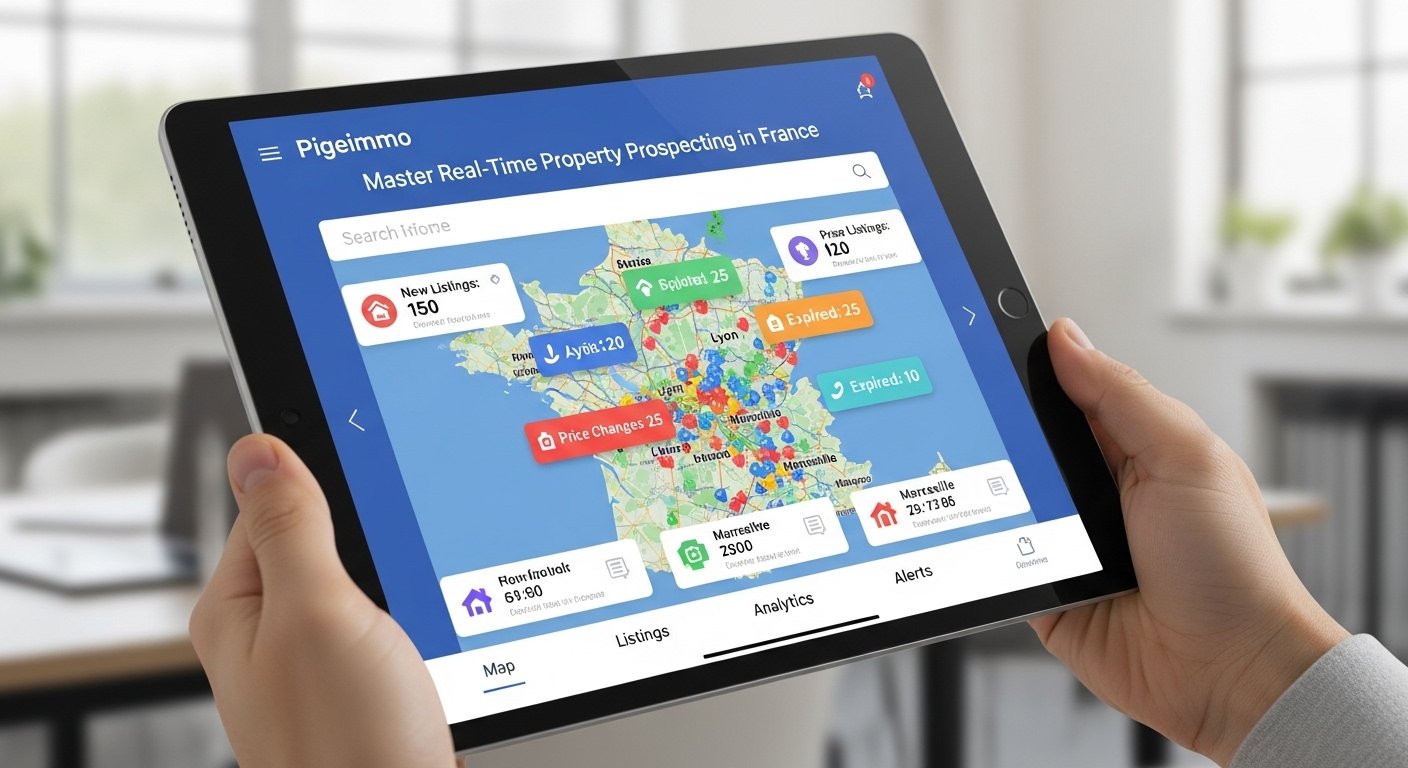
On a brisk Paris morning, a young real estate agent refreshes her dashboard while sipping espresso. Overnight, dozens of new listings have appeared across multiple property portals. Instead of manually scanning sites one by one, she opens a single interface that organizes everything in real time. That quiet shift in workflow is what makes tools like Pigeimmo compelling. In an industry where timing shapes opportunity, speed is not just an advantage. It is leverage.
Pigeimmo has emerged as a modern answer to an old real estate challenge: how to identify and act on property opportunities before competitors do. For entrepreneurs, proptech founders, and market watchers, its rise reflects a broader shift in how data is reshaping European real estate. Beneath the surface, this is not just about software. It is about the evolution of prospecting itself.
The Changing Rhythm of Real Estate Prospecting
Property markets have always been driven by information asymmetry. The first agent to discover a listing often wins the mandate. Historically, that edge came from local relationships and physical presence. Agents walked neighborhoods, built networks, and relied on instinct.
Digital transformation rewrote those rules. Online portals created a flood of publicly available listings, but they also introduced a paradox. More data meant more competition and less time to react. Agents who once relied on intuition suddenly faced the challenge of filtering signal from noise.
This is where platforms like Pigeimmo entered the conversation. By aggregating listings from multiple sources and presenting them in a unified interface, the platform compresses the discovery cycle. Instead of spending hours scanning websites, professionals can shift their focus to strategy and outreach.
What Pigeimmo Actually Does
At its core, Pigeimmo functions as a real-time property monitoring system tailored for the French real estate market. It tracks listings across major portals, analyzes changes, and surfaces actionable insights. But describing it purely as a scraping or monitoring tool misses the larger picture.
The platform sits at the intersection of data aggregation and workflow optimization. It does not merely collect listings. It organizes them in ways that support decision-making. Agents can filter by geography, price trends, listing age, and even duplicate postings. The result is clarity in a crowded market.
For founders exploring proptech models, this highlights an important shift. The value is no longer in access to data alone. It lies in interpretation, speed, and usability.
Why France Became Fertile Ground
France offers a unique backdrop for this kind of innovation. Its property market is large yet fragmented, with regional nuances that challenge both local and international players. While digital adoption has accelerated, many agencies still operate with hybrid workflows that blend analog habits with modern tools.
This creates an opportunity gap. Platforms that simplify discovery and prospecting can deliver immediate value without requiring massive behavioral change. Pigeimmo fits neatly into that space. It enhances what agents already do rather than replacing it entirely.
For entrepreneurs, the lesson is subtle but important. The most successful proptech solutions often evolve within existing ecosystems instead of trying to disrupt them overnight.
The Data Advantage in Real-Time Markets
Speed is the most obvious benefit of real-time prospecting, but the deeper advantage lies in pattern recognition. When agents can observe listings as they appear and evolve, they begin to see market dynamics more clearly.
Consider price adjustments. A listing that drops in price within days may signal urgency. A property that appears repeatedly across portals could indicate overexposure. These micro-signals, once invisible, become actionable intelligence when surfaced in a centralized dashboard.
Pigeimmo’s approach reflects a broader truth about modern markets: insight compounds when data is continuous. Real-time visibility transforms isolated observations into trends.
A Tool That Changes Behavior
Technology does not just accelerate tasks. It reshapes habits. Agents who rely on manual prospecting often operate reactively, chasing listings after they gain traction. Real-time monitoring shifts that posture toward proactivity.
When discovery becomes instantaneous, outreach becomes more strategic. Agents can contact owners earlier, craft tailored pitches, and prioritize high-potential leads. Over time, this alters how professionals allocate attention.
For founders studying productivity software, this behavioral shift is the real story. Tools like Pigeimmo do not merely save time. They redistribute it toward higher-value work.
Comparing Traditional vs. Real-Time Prospecting
To understand the transformation more clearly, it helps to contrast legacy workflows with modern approaches.
| Dimension | Traditional Prospecting | Real-Time Prospecting with Pigeimmo |
|---|---|---|
| Listing Discovery | Manual portal browsing | Automated multi-source monitoring |
| Reaction Time | Hours or days | Near-instant alerts |
| Data Interpretation | Fragmented and subjective | Aggregated and structured insights |
| Competitive Edge | Local knowledge driven | Data and speed driven |
| Workflow Efficiency | Time-intensive | Streamlined and scalable |
This shift mirrors patterns seen across other industries. Finance, logistics, and media all experienced similar transitions once real-time data became accessible. Real estate is simply catching up.
The Entrepreneurial Lens
For startup founders, Pigeimmo offers more than a case study in niche software. It illustrates how vertical SaaS continues to unlock value in specialized markets. While global platforms chase scale, localized tools often win by solving specific, high-friction problems.
The proptech ecosystem has long been dominated by marketplace models. Yet the quiet growth of operational tools suggests a second wave. Platforms that enhance professional workflows may ultimately prove more durable than those attempting to reinvent entire marketplaces.
In this context, Pigeimmo’s positioning is instructive. It focuses on a narrow use case but executes with depth. That combination often signals long-term relevance.
Challenges and Considerations
No tool operates in a vacuum. Real-time prospecting introduces its own set of questions. As more agents adopt similar technologies, the competitive advantage narrows. Speed becomes table stakes rather than differentiation.
There are also ethical and regulatory considerations. Data aggregation must align with platform policies and regional regulations. In Europe, where privacy frameworks are robust, compliance is not optional. Any proptech solution operating in this space must balance innovation with responsibility.
For founders building adjacent tools, this serves as a reminder that sustainable innovation often requires regulatory fluency as much as technical expertise.
The Human Element Still Matters
It is tempting to frame real-time prospecting as a purely technological story, but real estate remains deeply human. Relationships, trust, and local knowledge still shape outcomes. No dashboard can replace the nuance of negotiation or the emotional dynamics of property transactions.
What tools like Pigeimmo do is amplify human capability. They remove friction from discovery so professionals can invest more energy in relationship-building. In many ways, this aligns with a broader trend across knowledge industries. Automation handles the repetitive. Humans focus on judgment.
This balance is where meaningful productivity gains emerge. Not from replacing people, but from augmenting them.
Signals for the Future of Proptech
Looking ahead, platforms that succeed in real estate will likely share several traits. They will prioritize interoperability, integrating with CRMs and communication tools. They will emphasize predictive insights, moving beyond monitoring into forecasting. And they will lean into usability, recognizing that adoption hinges on simplicity.
Pigeimmo hints at this trajectory. Real-time monitoring may be the entry point, but the next frontier lies in intelligence layers that anticipate opportunity rather than merely revealing it.
For investors and founders alike, this evolution is worth watching. Real estate may be slow-moving on the surface, but its digital undercurrents are accelerating.
Why It Resonates Beyond France
While Pigeimmo is deeply rooted in the French market, the underlying thesis travels well. Every fragmented real estate ecosystem contains inefficiencies waiting to be compressed by data. From Southern Europe to parts of Asia, similar conditions exist.
The global proptech landscape is often shaped by local champions that refine models before they scale outward. Whether Pigeimmo remains regionally focused or inspires parallel solutions elsewhere, its influence may extend further than its immediate footprint.
For tech readers, this is a familiar pattern. Innovation often starts narrow and grows outward through adaptation.
Conclusion
Pigeimmo represents more than a clever real estate tool. It reflects a shift in how professionals engage with opportunity. In a market where timing defines success, real-time prospecting transforms discovery from a slow grind into a strategic advantage.
For entrepreneurs and founders, the lesson is clear. The next wave of proptech will not be defined solely by marketplaces or big platforms. It will be shaped by focused solutions that sharpen decision-making at the ground level.
In the end, the story of Pigeimmo is not just about property listings in France. It is about the quiet power of better information, delivered at the right moment. And in business, that timing often makes all the difference.